
In short
- In an orthopedic workshop the CNC machine is a milling machine that turns the patient’s file into a polyurethane positive: body jackets, AFOs and KAFOs, prosthetic sockets, insoles, cosmetic covers and lasts.
- It automates the slowest and messiest part of the job, the plaster model: the technician stays on modelling and thermoforming, the machine works on its own.
- With the ORTHO 1004 EVO a body jacket is milled in 15-20 minutes and an AFO in 10-15; with the compact OCM a body jacket takes about an hour.
In an orthopedic workshop, “automation” does not mean a production line: it means taking the repetitive steps away from the technician and leaving the ones where their hands make the difference. This guide explains what a CNC machine for orthopedics does, what it makes, how long it takes and how to choose the right one.
1. What a CNC machine does in an orthopedic workshop
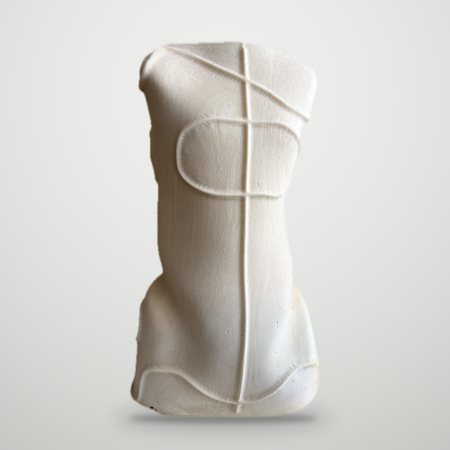
The CNC machine used in orthopedics is a milling machine: a tool spinning at high speed removes material from a block of polyurethane foam, following the path calculated by the software, until the patient’s shape is left. It is the same positive that used to come from the plaster cast, but without plaster, without rasping and with the exact shape of the file.
From there the workshop carries on as it always has: thermoforming, trimming, finishing, fitting. It is the most direct way to take custom device production digital, because only the model step changes and everything else stays the same.
2. What gets automated, and what does not
| Step | With plaster | With the CNC milling machine |
|---|---|---|
| Taking the shape | plaster cast on the patient | 3D scan |
| Positive | pouring, drying, rasping and corrections by hand | modelling on the computer, automatic milling |
| Remaking a device | new cast | same file, new milling |
| Thermoforming and finishing | the technician | the technician |
The technician’s skill stays at the centre: they decide corrections, pressure and relief areas, and finish the device. What the machine takes away is the repetitive work, the plaster dust and the waiting time. While it mills, the technician can thermoform the previous part.
3. Body jackets, orthoses, prostheses and insoles: what gets milled
- Body jackets and corsets: the trunk positive to thermoform on.
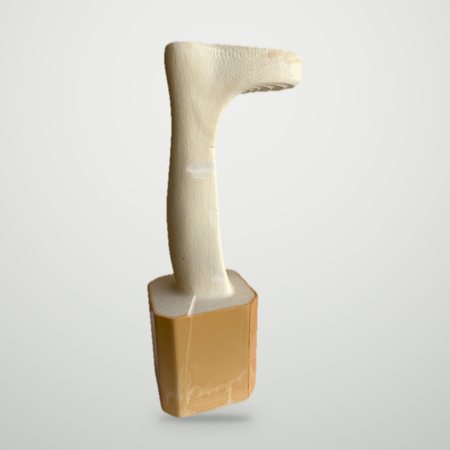
- AFOs and KAFOs: more complex shapes that need the fourth axis.
- Prosthetic sockets: the positive of the residual limb to build the socket.
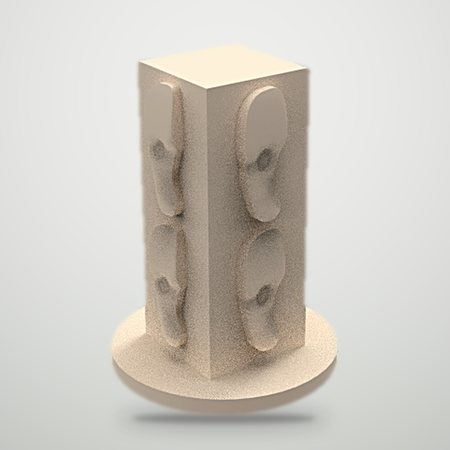
- Insoles: the positives, including several pairs from one block.
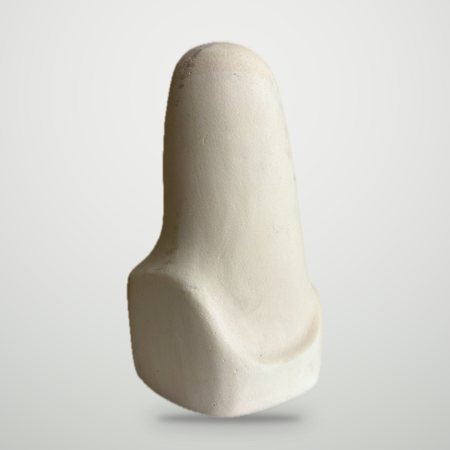
- Leg and calf cosmetic covers, shoe lasts, cranial helmets and seating systems.
4. 3 or 4 axes?
More axes mean more freedom of movement for the tool around the block. A 3-axis milling machine is enough for body jackets, lower-limb sockets and insole positives, and it is the simplest configuration. The fourth axis rotates the block during machining and allows geometries that cannot be done on 3 axes: it is what you need for AFOs and KAFOs, cosmetic covers, lasts and helmets.
Dedicated accessories mount on the fourth axis of the ORTHO 1004 EVO, one for each type of part: the same machine moves from body jacket to insole by changing only the fixture.
5. Materials and blocks
Milling machines for orthopedics dry-machine polyurethane foams up to 800 kg/m³, as well as wood, resin and foam rubber. The maximum block size sets the size of the devices: the OCM takes blocks up to 500 mm in diameter and 660 mm long, the ORTHO 1004 EVO up to 650 mm and 1100 mm.
6. Machining times
| Device | ORTHO 1004 EVO | OCM |
|---|---|---|
| Body-jacket positive | 15-20 minutes | about an hour |
| AFO positive | 10-15 minutes | — (needs the fourth axis) |
Machine time matters less than it seems: the real saving is the manual work that disappears and the ability to remake a device from the file. The savings calculator does the maths with your workshop’s figures.
Want to see milling live? Book a free demo or calculate your savings.
7. Software and programming
You do not need a CAM programmer. On Satres machines the job is prepared at the machine with OrthoCAM and the OrthoLIB library: guided procedures, preset roughing and finishing parameters, toolpath simulation and collision checking before starting.
The system is open: the machine accepts STL files from any orthopedic CAD software, so the workshop keeps modelling with the program it already knows.
8. Space, power and dust
- OCM: about 80 × 120 cm, 250 kg on wheels, runs on 220 V.
- ORTHO 1004 EVO: less than 85 cm wide, fits through a standard door; runs on 380 V, or 220 V as an option.
- Dust: milled polyurethane produces a lot of it. You need extraction and an area separate from where patients are seen.
9. Which machine for which workshop
In short
- OCM, if you are going digital and mostly make body jackets, but also lower-limb sockets and insole positives. Compact, runs on 220 V.
- ORTHO 1004 EVO, if you make a bit of everything, in volume: faster body jackets, AFOs and KAFOs, helmets, leg-foot models, cosmetic covers and shoe lasts.
- Helios HS, if you also want to drop thermoforming and print the device directly: see the guide to 3D printing for orthopedics.
The full comparison between milling and 3D printing, with costs and space, is in the buying guide. And on the work made with Satres machines page you will find real parts made with the ORTHO 1004 EVO.
10. Frequently asked questions
Do I need to know how to program a CNC machine?
No. With OrthoCAM the job is prepared at the machine with guided procedures; training takes one or two days.
Does the milling machine replace the orthotist?
No. It replaces the plaster cast and the manual preparation of the positive. Corrections, thermoforming and finishing stay with the technician.
What happens if the machine stops?
We answer the same day and, through the network connection, we can see the machine remotely too. Everything is explained on the training and support page.
Is there a dealer in my country?
In some countries we work with dealers; elsewhere, directly with you: the list is on the dealers page.
Want to see your shape milled?
Send us a file or tell us which devices you make: in our demo area in Navacchio (Italy), or by video call, we will show you the machine working on a part like yours.